

1. Introduction
A Compact Traction Home Elevator is a space-efficient Residential Elevator designed to provide convenient vertical transportation in private houses, villas, duplex homes, townhouses, and other low-rise residential buildings. It combines traction drive technology with a compact structural design, making it suitable for projects where available installation space is limited but reliable multi-floor transportation is still required.
As modern residential architecture continues to focus on accessibility, comfort, efficient use of space, and attractive interior design, Compact Home Elevators are becoming an increasingly practical option. A Compact Traction Home Elevator can connect multiple floors while reducing the need for extensive mechanical space compared with some conventional elevator configurations.
The traction system normally uses an electric traction machine, traction sheave, suspension ropes or belts, guide rails, counterweight, elevator cabin, controller, landing doors, and safety equipment. The counterweight helps balance the cabin and part of the rated load, allowing the traction motor to operate efficiently.
One of the most important characteristics of a compact traction home elevator is its ability to integrate into residential architecture. The elevator can be designed around the available shaft dimensions, floor height, travel distance, cabin capacity, entrance configuration, and interior requirements.
Depending on the model, homeowners can select different cabin finishes, doors, lighting systems, control panels, handrails, mirrors, glass panels, and decorative materials. This makes the elevator suitable for both practical family residences and luxury villa projects.
A Compact Traction Home Elevator can be considered during the initial architectural design stage or as part of a residential renovation project, provided that the existing building can accommodate the necessary elevator structure and safety requirements.
2. What Is a Compact Traction Home Elevator?
A Compact Traction Home Elevator is a residential elevator that uses an electric traction drive system to move a cabin vertically between different floors.
The basic operating principle involves a traction machine and sheave connected to a suspension system. The elevator cabin moves along guide rails while a counterweight balances the cabin and a portion of its rated load.
The controller manages elevator movement, acceleration, deceleration, door operation, floor selection, leveling, and safety monitoring.
The word “compact” refers primarily to the optimized design of the elevator system rather than a universal fixed dimension. Different manufacturers may offer different shaft sizes, cabin dimensions, machine arrangements, and counterweight configurations.
Therefore, the actual space requirement should always be confirmed using the manufacturer's technical drawings.
Compact traction elevators are especially useful in residential environments because they can provide efficient vertical transportation without necessarily requiring the same spatial arrangement as a conventional commercial passenger elevator.
3. Typical Parameters of a Compact Traction Home Elevator
The following parameters represent common residential configurations and should be used as reference values rather than fixed specifications.
Product Type | Compact Traction Home Elevator |
Application | Houses, Villas, Duplex Homes, Townhouses |
Drive Type | Electric Traction Drive |
Typical Capacity | 250–630 kg |
Passenger Capacity | Approximately 2–8 Persons |
Typical Speed | 0.3–1.0 m/s |
Typical Floors | 2–6 Floors |
Control System | Microcomputer / VVVF Control |
Drive System | Traction Machine With Counterweight |
Cabin Type | Compact Residential Cabin |
Door Type | Manual or Automatic |
Entrance | Single / Customized |
Cabin Material | Stainless Steel, Glass, Decorative Panels |
Lighting | LED Lighting |
Leveling | Automatic Floor Leveling |
Safety Protection | Multiple Safety Systems |
Installation | Indoor Residential Application |
Power Supply | According to Local Electrical Standard |
Customization | Cabin, Capacity, Door, Size, Finish |
Actual capacity, speed, cabin dimensions, shaft dimensions, pit depth, headroom, motor power, and electrical specifications depend on the selected elevator model.
For a project quotation, the manufacturer should normally receive the architectural dimensions and project requirements before confirming the final technical parameters.
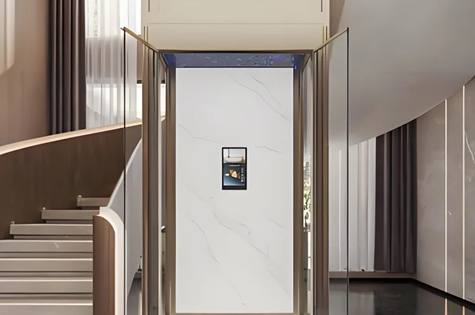
4. Main Features
The compact configuration is one of the main advantages of this type of residential elevator.
Private houses often have limited space for an elevator shaft. A compact traction design can help architects and homeowners optimize the available area while maintaining appropriate cabin dimensions and safety clearances.
The exact space-saving effect depends on the selected model, so technical drawings should always be reviewed before construction.
The traction machine works together with a counterweight and suspension system. The counterweight helps balance the cabin and part of the passenger load.
This configuration can reduce the lifting effort required from the motor and contribute to efficient elevator operation.
Modern traction home elevators can use variable-frequency drive technology to control acceleration and deceleration.
Controlled speed changes can reduce sudden movement and provide a more comfortable passenger experience.
Automatic leveling allows the cabin to stop accurately at the selected floor.
Accurate leveling is important for residential accessibility because it helps minimize the step between the cabin floor and the landing floor.
Compact does not mean basic.
The elevator cabin can be designed with modern interior materials such as stainless steel, tempered glass, decorative panels, mirrors, wood-effect finishes, and customized lighting.
The elevator can potentially be customized according to:
Cabin dimensions
Rated capacity
Number of floors
Travel height
Door arrangement
Cabin materials
Lighting
Control panel
Handrails
Exterior finish
Depending on the model and applicable regulations, a Compact Traction Home Elevator may include door interlocks, overspeed protection, safety gear, limit switches, overload protection, emergency stop functions, emergency lighting, alarms, and other safety devices.
5. Advantages of Compact Traction Home Elevator
The compact design is particularly beneficial for residential projects where the available shaft area is limited.
Efficient arrangement of elevator equipment can help reduce unnecessary use of valuable residential floor space.
The counterweight system helps balance the elevator cabin and part of the load.
As a result, the traction motor does not need to lift the entire cabin mass and passenger load directly.
Actual energy consumption depends on elevator capacity, speed, travel height, frequency of use, motor efficiency, controller efficiency, and other factors.
Traction technology combined with modern control systems can provide smooth acceleration, controlled deceleration, and accurate leveling.
This makes the elevator comfortable for regular residential use.
Many villas contain multiple floors and large vertical distances between living areas.
A compact home elevator can provide convenient access between bedrooms, living rooms, kitchens, garages, and other areas.
An elevator can reduce the need for frequent stair use and make multi-level homes easier to navigate.
This can be particularly valuable for long-term residential accessibility planning.
The elevator cabin can be coordinated with the architectural style of the home.
Different materials, colors, finishes, lighting arrangements, and control panels can be considered.
A home elevator can increase the practical usability of a multi-story residence.
It can also make a property more adaptable to changing household needs over time.
6. How Does a Compact Traction Home Elevator Work?
A Compact Traction Home Elevator operates through coordinated mechanical and electrical systems.
The user presses the landing call button.
The controller receives the request and determines the elevator's operating direction.
The traction system moves the cabin toward the requested landing.
When the elevator reaches the landing, the doors open after the control system confirms the required safety conditions.
The passenger enters the cabin and presses the desired floor button.
The controller activates the traction motor.
The traction sheave moves the suspension system while the cabin travels along the guide rails.
Sensors monitor the cabin position and movement throughout the journey.
As the cabin approaches the destination floor, the control system reduces the speed.
The elevator automatically performs final leveling to align the cabin floor with the landing.
Once the elevator reaches the correct position and the safety system confirms normal conditions, the doors open.
7. Application Scenarios
Large villas are one of the most common applications for Compact Residential Elevators.
A multi-floor villa may contain bedrooms on upper floors, living areas on the ground floor, and entertainment or storage spaces elsewhere.
A compact traction elevator can connect these areas and improve daily transportation.
Duplex houses can benefit from a home elevator because residents frequently travel between two main residential levels.
A compact elevator can provide an alternative to stairs without significantly changing the overall interior layout.
Townhouses typically have narrow floor plans and multiple levels.
A space-efficient traction elevator can be integrated into a suitable section of the building to improve vertical accessibility.
Luxury residences often require both functionality and attractive design.
A customized compact traction elevator can include premium cabin finishes, glass elements, decorative lighting, mirrors, and stainless steel components.
Existing homes may also benefit from elevator installation.
However, renovation projects require careful evaluation of structural conditions, available space, pit requirements, headroom, electrical capacity, and local regulations.
Home elevators can support long-term accessibility by reducing dependence on stairs.
This is particularly useful for families planning to remain in a multi-story property for many years.
Small private residential buildings with several floors can also consider compact traction elevator systems where a full commercial elevator installation would be excessive for the intended application.
8. Installation Requirements
The shaft must provide enough space for the cabin, guide rails, doors, safety clearances, and other components.
The required shaft dimensions vary according to the selected model.
The elevator pit provides the necessary space beneath the lowest landing for safety and equipment requirements.
Pit dimensions vary between elevator configurations.
Sufficient space above the highest landing is required for safe operation and maintenance.
The floor-to-floor dimensions should be provided to the manufacturer.
These measurements affect elevator travel, door positioning, guide rail arrangement, and other technical requirements.
The building structure must be suitable for the elevator installation.
For existing buildings, a structural assessment may be necessary.
The elevator requires an appropriate electrical supply for the traction motor, controller, doors, lighting, and other equipment.
The exact voltage, frequency, phase, and protection requirements should be confirmed according to the local electrical system.
The elevator equipment should be installed in an environment that meets the manufacturer's temperature, humidity, ventilation, and other environmental requirements.
Elevator installation must comply with applicable local building regulations, elevator standards, electrical codes, inspection requirements, and safety regulations.
9. Usage Instructions
Check that the landing area is clean and free of obstructions.
Do not use the elevator if there is visible damage or an abnormal operating condition.
Press the landing call button and wait for the cabin to arrive.
Do not repeatedly press the button unless the control system specifically requires it.
Wait until the doors are completely open.
Enter carefully and avoid blocking the door sensors.
Press the desired floor button once.
Wait for the elevator to begin moving.
Remain inside the cabin until the elevator reaches the selected floor.
Do not attempt to open the doors manually.
Do not exceed the rated capacity.
Heavy items should be distributed evenly inside the cabin.
If the elevator stops unexpectedly, remain calm and stay inside the cabin.
Use the emergency alarm or communication system if available.
Do not force the doors open or attempt to climb out.
10. Maintenance Guide
Regular maintenance is essential for the safe and reliable operation of a Compact Traction Home Elevator.
Professional maintenance should include inspection of:
Traction machine
Traction sheave
Suspension ropes or belts
Counterweight
Guide rails
Guide shoes
Door system
Door interlocks
Safety gear
Overspeed protection
Limit switches
Controller
Electrical wiring
Drive system
Leveling sensors
Emergency lighting
Alarm system
Cabin lighting
Mechanical fasteners
Maintenance frequency should follow the manufacturer's recommendations and applicable local requirements.
Homeowners should not attempt to repair traction machinery, electrical control equipment, safety gear, or other critical elevator components.
11. Common Problems and Solutions
Possible causes include:
Power interruption
Door not fully closed
Emergency stop activated
Safety circuit interruption
Controller fault
Check the basic operating conditions. If the elevator remains inactive, contact qualified maintenance personnel.
Possible causes include an obstruction, sensor issue, door mechanism problem, or door interlock fault.
Check for visible obstructions and keep the doorway clear.
Never force the doors.
Unusual sounds may come from the traction machine, guide system, doors, suspension system, or other mechanical components.
The elevator should be inspected by a qualified technician.
Potential causes include leveling sensor problems, control-system calibration issues, or mechanical faults.
Professional inspection may be required.
An unexpected stop can result from a power interruption or activation of a safety system.
Passengers should remain inside the cabin and use the emergency communication or alarm system where available.
12. Safety Features
Safety is a fundamental consideration when selecting a Compact Traction Home Elevator.
Depending on the elevator model, typical protection functions may include:
The elevator should not operate normally when the required doors are not securely closed.
An overspeed protection system can detect abnormal elevator speed and activate appropriate safety functions.
Safety gear can provide additional protection in certain abnormal operating conditions.
The elevator control system can prevent normal operation when the rated capacity is exceeded.
Upper and lower limit protection helps prevent the elevator from traveling beyond its designed operating range.
An emergency alarm allows passengers to request assistance when necessary.
Emergency lighting can help provide illumination during a power interruption.
Automatic leveling helps align the cabin floor with the landing floor.
The complete safety configuration should always be verified against the specific elevator model and local regulatory requirements.
13. Customization Options
The cabin can be configured according to available shaft space and passenger requirements.
Different residential capacities can be considered depending on the number of users and intended application.
Common choices include:
Stainless Steel
Tempered Glass
Decorative Panels
Wood-Effect Panels
Laminated Materials
Mirrors
LED ceiling lighting can create a modern and comfortable cabin environment.
Landing doors can be selected to match surrounding architectural materials.
The cabin control panel can include floor selection buttons, door controls, emergency alarm functions, and other operating controls.
Handrails can improve passenger comfort and accessibility.
14. Compact Traction Home Elevator for Small Houses
Space availability is often one of the biggest challenges when installing a home elevator.
A large commercial elevator system may require more room than a homeowner wants to allocate in a private residence.
A Compact Traction Home Elevator addresses this challenge by using a residential-oriented configuration designed around smaller building dimensions.
For small houses, the elevator can potentially be positioned near:
Staircases
Hallways
Entrance Areas
Central Living Areas
Existing Vertical Shafts
Exterior Building Extensions
The final location depends on structural conditions and applicable regulations.
Before construction, homeowners should obtain accurate technical drawings from the elevator supplier.
15. Compact Traction Home Elevator for Villas
Villas often have larger floor areas and multiple levels, making them particularly suitable for Residential Elevator Installation.
A compact traction elevator can connect:
Ground Floor
Living Floor
Bedroom Floor
Entertainment Floor
Roof Level
Basement or Garage Level
The elevator can also be integrated with architectural features such as staircases, glass walls, decorative panels, or central atriums.
For luxury villas, panoramic glass elements and customized cabin interiors can create an attractive visual effect while maintaining practical functionality.
16. Energy Efficiency
Traction elevators can provide efficient operation because the counterweight balances the cabin and part of the rated load.
Modern variable-frequency drives can further improve control of the motor during starting, acceleration, deceleration, and stopping.
However, actual energy consumption varies according to:
Elevator Capacity
Motor Power
Travel Height
Travel Speed
Usage Frequency
Control Technology
Standby Consumption
Door Operation
Building Conditions
Therefore, energy performance should be evaluated according to the complete elevator system rather than relying on a single specification.
17. Compact Traction Home Elevator vs. Hydraulic Home Elevator
Compact traction and hydraulic home elevators use different operating principles.
A traction elevator uses an electric traction machine, suspension system, and counterweight.
A hydraulic elevator uses hydraulic pressure to move a piston or cylinder.
Traction technology can be attractive for residential projects requiring efficient multi-floor operation and smooth travel.
Hydraulic systems can also be suitable for certain residential applications depending on building conditions and project requirements.
When comparing the two technologies, homeowners should consider:
Available Space
Number of Floors
Travel Height
Capacity
Energy Requirements
Installation Conditions
Structural Requirements
Maintenance
Local Regulations
Budget
The most appropriate solution depends on the individual building.
18. How to Select the Right Compact Traction Home Elevator
Identify all floors that need elevator service.
Accurate measurements should include shaft width, shaft depth, pit depth, headroom, and floor-to-floor height.
Select an appropriate rated capacity based on regular passenger requirements.
If the elevator will be used by people with mobility requirements, the cabin and door dimensions should be planned accordingly.
Determine whether the elevator requires a single entrance or another arrangement.
Select materials, lighting, mirrors, handrails, and decorative finishes.
Make sure the elevator system is compatible with the building's electrical supply.
Confirm all applicable local elevator, building, electrical, and safety requirements.
Consider technical support, installation guidance, spare parts availability, maintenance service, documentation, and warranty support.
19. Benefits for Homeowners
A Compact Traction Home Elevator can provide practical advantages throughout the life of a residential property.
Residents can travel between floors without relying entirely on stairs.
Household items such as luggage, groceries, laundry, and cleaning equipment can be transported more easily.
The elevator can make upper floors easier to reach for elderly residents and people with mobility limitations.
A compact configuration can help preserve valuable residential floor area.
Customized cabin interiors allow the elevator to match the architectural style of the home.
A home elevator can support changing household requirements as residents age or family needs evolve.
20. Frequently Asked Questions
A Compact Traction Home Elevator is a residential elevator that uses an electric traction drive system and compact structural arrangement to transport passengers between multiple floors of a private home.
Yes. Compact traction elevators are suitable for many villas, duplex homes, townhouses, and multi-level residences, provided that the building can accommodate the required elevator structure.
Residential configurations commonly range from approximately 250 kg to 630 kg, corresponding to different passenger capacities. The exact rated capacity depends on the selected model.
Many residential configurations are designed for approximately two to six floors, although actual capability depends on the specific elevator design and travel height.
The counterweight helps balance the cabin and part of the load, which can reduce the work required by the traction motor. Actual energy consumption depends on the complete elevator configuration and usage conditions.
This depends on the selected design. Some traction home elevators can use machine-room-less or compact machinery arrangements, while other configurations may require dedicated machinery space.
Potentially, yes. A professional assessment is required to determine whether the existing building can accommodate the shaft, pit, headroom, structural support, electrical system, and other requirements.
Depending on the manufacturer and model, cabin dimensions can often be customized within the available technical limits.
Yes. Stainless steel, glass, decorative panels, mirrors, wood-effect materials, LED lighting, and other finishes may be available.
Modern traction systems can provide relatively quiet operation when properly engineered, installed, and maintained. Noise levels depend on the drive system, guide system, doors, building structure, and installation quality.
Regular professional maintenance should inspect the traction machine, suspension system, guide rails, doors, controller, safety devices, leveling system, and electrical components.
Passengers should remain inside the cabin, stay calm, and use the emergency alarm or communication system if available. They should not force open the doors or attempt to leave without professional assistance.
Certain elevator models can be adapted for outdoor installation, but special consideration must be given to weather protection, electrical protection, structural support, environmental conditions, and local regulations.
Typical residential traction elevator speeds may range from approximately 0.3 to 1.0 m/s. The final speed depends on the model and project requirements.
The supplier should normally receive:
Number of Floors
Floor-to-Floor Height
Total Travel Height
Shaft Width
Shaft Depth
Pit Depth
Headroom
Desired Capacity
Cabin Size
Door Configuration
Power Supply
Installation Location
Cabin Design Requirements
Accurate information helps the supplier prepare a more suitable technical proposal.
21. Conclusion
A Compact Traction Home Elevator provides an efficient and practical solution for modern residential buildings that require convenient vertical transportation while making effective use of limited space.
Its traction drive system, counterweight arrangement, modern control technology, automatic leveling, customizable cabin design, and multiple safety functions make it suitable for villas, private houses, duplex homes, townhouses, and other low-rise residential buildings.
The compact design is particularly valuable in residential projects where architectural space must be carefully managed. Homeowners can select suitable cabin dimensions, capacity, door arrangements, materials, lighting, and interior finishes according to their individual requirements.
When selecting a Compact Traction Home Elevator, it is important to evaluate the entire project rather than focusing only on price or appearance. Shaft dimensions, travel height, capacity, electrical supply, structural conditions, safety requirements, maintenance, spare parts, installation, and after-sales service should all be considered.
For new residential construction, elevator planning should begin during the architectural design stage whenever possible. For existing homes, a professional site survey should be completed before selecting the final elevator model.
With appropriate engineering, professional installation, regular maintenance, and correct operation, a Compact Traction Home Elevator can provide comfortable, convenient, and reliable vertical transportation while improving the accessibility and long-term functionality of a multi-story home.
 RELATED
 RELATED
เว็บไซต์นี้ใช้คุกกี้เพื่อให้แน่ใจว่าคุณได้รับประสบการณ์ที่ดีที่สุดบนเว็บไซต์ของเรา
 English
 Indonesia
 Tiếng Việt
 Filipino



 โทรศัพท์