

1. Introduction
A Traction-type Backpack Home Elevator Balcony is a compact Residential Elevator solution designed for homes where a balcony provides a practical location for vertical transportation. By combining an electric traction drive system with a backpack-type elevator structure, this solution can connect different residential floors while making efficient use of existing outdoor or semi-outdoor space.
For many villas, duplex houses, self-built homes, and residential renovation projects, installing a conventional elevator inside the building can be difficult. Existing staircases, living areas, bedrooms, corridors, and structural walls may leave limited room for a traditional elevator shaft. A balcony can provide an alternative installation location, particularly when direct access between multiple floors is required.
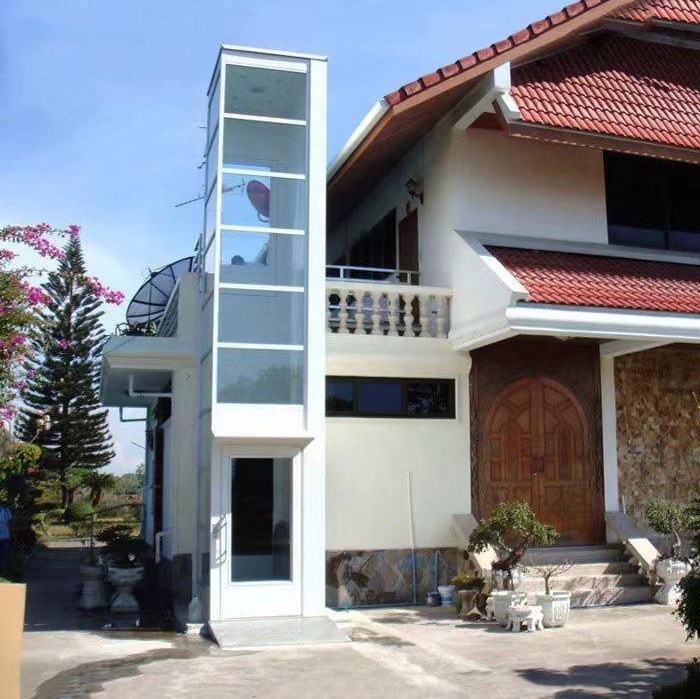
A balcony-mounted home elevator can create convenient access between floors without requiring major changes to the internal floor plan. Depending on the building design and local regulations, the elevator can be positioned adjacent to the exterior wall, with landing entrances connecting directly to balconies or other residential areas.
The backpack-type structure is especially useful for compact residential applications because its supporting components are arranged toward one side of the elevator car. This configuration can provide greater flexibility when planning the elevator around existing architectural features.
The traction system uses an electric motor and traction mechanism to move the elevator car. Through coordinated operation of the motor, traction components, controller, guide system, doors, and safety devices, the elevator can provide controlled movement between residential floors.
A Traction-type Backpack Home Elevator Balcony can therefore be considered when homeowners need a combination of accessibility, space efficiency, architectural flexibility, and modern residential elevator technology.
2. What Is a Traction-type Backpack Home Elevator Balcony?
The product name describes the elevator's main application and structural characteristics.
The elevator uses an electric traction drive system. A motor rotates a traction sheave, allowing traction elements to move the elevator car through the guide system.
The backpack configuration positions the main supporting guide structure toward one side of the elevator car. This can allow the elevator to be installed close to an exterior wall or other architectural structure.
The elevator can be designed to serve residential floors through balcony access. Depending on the building design, passengers may enter the elevator from balconies, terraces, exterior corridors, or other suitable landing areas.
This approach can be particularly useful when there is insufficient indoor space for a conventional elevator shaft.
3. How Does a Traction Balcony Home Elevator Work?
The basic operating principle is similar to other traction elevators.
When the passenger presses a destination button, the elevator control system receives the command. Before movement begins, the controller checks the relevant safety conditions.
If all required safety circuits are satisfied, the traction motor starts.
The traction system then moves the elevator car along its guide rails. A balancing arrangement, such as a counterweight depending on the specific design, can reduce the lifting effort required from the motor.
The controller manages:
Starting
Acceleration
Constant-speed movement
Deceleration
Floor leveling
Door operation
Safety monitoring
As the elevator approaches the selected floor, the controller reduces the speed. The elevator then performs the final leveling operation before the landing and cabin doors are released.
For balcony applications, precise leveling is particularly important because passengers may be entering and exiting directly from residential outdoor areas.
4. Typical Specifications
The specifications of a Traction-type Backpack Home Elevator Balcony can be customized according to the building structure and project requirements.
Product Type | Traction-type Backpack Home Elevator |
Application | Balcony, Villa, Duplex, Residential Building |
Drive System | Electric Traction |
Structure | Backpack Type |
Installation | Balcony / Exterior Wall / Indoor |
Floors | 2–4 Floors or Customized |
Rated Load | Approximately 250–450 kg or Customized |
Passenger Capacity | Approximately 2–5 Persons |
Speed | Residential Low-Speed Configuration |
Cabin Size | Customized |
Door Configuration | Customized |
Guide Structure | Side-mounted Backpack Arrangement |
Cabin Material | Stainless Steel / Glass / Aluminum / Customized |
Control System | Residential Elevator Control System |
Power Supply | According to Local Electrical Standard |
Safety System | Multiple Safety Protection Functions |
Lighting | LED or Customized |
Emergency Functions | Alarm / Lighting / Backup Options |
Weather Protection | Required for Outdoor Installation |
Customization | Available |
These are general reference parameters rather than fixed specifications. The final rated load, cabin dimensions, speed, motor power, pit requirements, overhead requirements, travel height, and other technical data must be confirmed with the manufacturer.
5. Main Features
The most distinctive feature is the ability to integrate the elevator with a balcony-based access arrangement.
Instead of occupying valuable indoor floor space, the elevator can potentially be positioned outside the main living area.
This can be useful for buildings where:
Indoor space is limited
Staircases occupy the central floor area
Existing rooms cannot easily be redesigned
An external elevator is architecturally acceptable
Balconies already exist on multiple floors
The feasibility of balcony installation depends on the building structure and local regulations.
The backpack design can provide an efficient arrangement of the elevator's supporting components.
By positioning the guide and supporting structure toward one side, the elevator can potentially be placed closer to an exterior wall.
This is particularly beneficial for residential renovation projects because the available installation area may be irregular or restricted.
The traction system provides controlled electric movement.
Key benefits can include:
Smooth acceleration
Controlled deceleration
Accurate floor leveling
Efficient motor operation
Stable movement
Convenient residential control
The actual performance depends on the motor, controller, load, speed, travel height, and elevator design.
Residential balconies are usually designed as functional outdoor spaces rather than equipment rooms.
A compact elevator configuration can help minimize the amount of space occupied by the vertical transportation system.
This allows homeowners to maintain more usable space around the elevator landing.
The elevator cabin can be adapted to the architectural style of the home.
Possible options include:
Stainless steel panels
Tempered glass
Aluminum
Decorative wall panels
Customized flooring
LED lighting
Handrails
Customized operating panels
For a modern villa, a glass cabin can provide a panoramic appearance. For a traditional home, a more discreet finish may better match the building exterior.
6. Advantages of a Balcony-mounted Home Elevator
One of the biggest advantages of a balcony installation is that the elevator does not necessarily need to occupy a central position inside the house.
This can preserve:
Living room space
Bedroom space
Staircase space
Hallway space
Kitchen space
Storage space
For small residential buildings, this can significantly improve the practicality of the installation.
Installing an elevator into an existing house can be more complicated than incorporating one into a new building.
An external balcony arrangement can provide another option when interior reconstruction is difficult.
This can make the concept suitable for:
Existing villas
Duplex homes
Self-built houses
Older residential buildings
Home renovation projects
A professional site assessment is required before confirming feasibility.
Stairs can become inconvenient when residents need to carry heavy objects or when family members have difficulty climbing stairs.
A residential elevator provides an alternative method of moving between floors.
Typical users may include:
Elderly family members
Children
Residents with mobility limitations
People carrying groceries
People carrying luggage
Residents moving household items
A balcony elevator can connect multiple residential floors.
For example, it may connect:
Ground Floor → First Floor → Second Floor → Third Floor
depending on the elevator configuration.
The landing doors can be positioned to align with balconies or other suitable access points.
The elevator can become either a visible architectural feature or a discreet functional addition.
With customized glass, stainless steel, aluminum, colors, lighting, and enclosure structures, the elevator can be integrated into different building styles.
7. Balcony Installation Applications
Large villas may have multiple balconies distributed across several floors.
A traction Backpack Elevator can provide convenient access between these levels while reducing the need for major internal floor modifications.
The elevator can be positioned near the building facade and connected to each balcony.
For a two-story duplex, the elevator can connect the main floor and upper floor.
A balcony-based installation can be useful when there is insufficient space for an indoor elevator.
The elevator may provide access to:
Bedrooms
Living rooms
Upper terraces
Home offices
Storage areas
Renovating an existing home can create significant structural challenges.
A balcony elevator can sometimes reduce the need to remove walls or redesign the internal staircase.
The existing balcony structure should be inspected to determine whether reinforcement is necessary.
Self-built houses often provide greater flexibility in architectural planning.
An external elevator can be incorporated during construction or added after the main building has been completed.
A balcony home elevator can support families with members of different ages.
Instead of requiring older family members to use stairs several times each day, the elevator can provide easier access to bedrooms and other upper-floor living spaces.
8. Important Balcony Installation Considerations
Installing a home elevator on a balcony requires more than simply placing elevator equipment outside the building.
The balcony and building structure must be capable of supporting the elevator and associated loads.
A qualified engineer should evaluate:
Balcony slab
Supporting beams
Columns
Anchor points
Wall structure
Foundation
Dynamic loads
Additional steel structures or reinforced foundations may be required.
Outdoor elevators are exposed to environmental conditions.
Depending on the local climate, protection may be required against:
Rain
Humidity
Strong sunlight
Wind
Dust
Temperature changes
Corrosion
A protective elevator enclosure can help extend equipment service life.
Water drainage is an important consideration for outdoor elevator installations.
The landing area should prevent rainwater from entering sensitive electrical or mechanical components.
For coastal or humid environments, appropriate materials and surface treatments should be considered.
Stainless steel, galvanized components, protective coatings, sealed electrical enclosures, and suitable fasteners may be used depending on the project.
9. Installation Process
The first step is to measure the building.
Important information includes:
Number of floors
Floor-to-floor height
Balcony dimensions
Travel height
Available width
Available depth
Wall structure
Foundation condition
Electrical supply
The elevator location should provide convenient access while avoiding conflicts with:
Windows
Doors
Balustrades
Drainage
Roof structures
Air-conditioning equipment
Existing utility lines
The building structure should be evaluated before installation.
If the balcony cannot directly support the elevator, a dedicated supporting steel frame or foundation may be required.
The elevator manufacturer can develop technical drawings based on the site dimensions.
These drawings may include:
Cabin dimensions
Landing positions
Guide rail positions
Door dimensions
Motor arrangement
Electrical requirements
Structural support details
Qualified technicians install the structural components, guide system, traction equipment, cabin, doors, electrical control system, and safety devices.
After installation, the elevator should be tested for:
Door operation
Leveling
Load performance
Emergency functions
Safety circuits
Travel operation
Control system
Alarm system
The elevator should only be placed into normal service after required inspections and acceptance procedures have been completed.
10. How to Use the Elevator Safely
Operating a residential balcony elevator is simple, but users should follow basic safety procedures.
Wait until the elevator arrives and the landing door opens completely.
Check that the cabin floor is properly aligned with the landing before entering.
Press the button for the desired floor.
Avoid pressing buttons unnecessarily or interfering with the control panel.
Remain inside the cabin.
Do not lean against the doors or attempt to open them while the elevator is moving.
Wait for the elevator to stop completely.
After the door opens, check the landing area before exiting.
Children should be supervised when using the elevator.
11. Maintenance Requirements
Regular professional maintenance helps keep a residential traction elevator reliable.
Important maintenance areas include:
Technicians should inspect the motor, traction components, ropes or traction elements, and related mechanical parts.
Guide rails and associated components should be inspected for wear, alignment, and proper operation.
Door panels, locks, interlocks, sensors, and opening mechanisms should be checked.
The controller, wiring, sensors, emergency circuits, and electrical connections should be inspected.
Safety devices should be tested according to the manufacturer's maintenance requirements.
For balcony installations, technicians should also inspect:
Protective enclosure
Structural frame
Corrosion
Water ingress
Drainage
Fasteners
Sealing
Maintenance frequency should follow the manufacturer's recommendations and applicable local regulations.
12. Energy Efficiency
A residential elevator generally operates intermittently rather than continuously.
Energy consumption depends on:
Motor efficiency
Rated load
Travel height
Number of trips
Controller
Lighting
Standby functions
Door operation
Traction systems can be designed with efficient motors and controllers for residential use.
However, actual electricity consumption should always be evaluated using the technical specifications of the selected elevator rather than using a generic estimate.
13. Safety Features
A modern home elevator should use multiple layers of safety protection.
Depending on the model, safety functions may include:
Door interlock
Overload protection
Overspeed protection
Emergency braking
Emergency stop
Door obstruction detection
Emergency alarm
Emergency lighting
Automatic leveling
Power failure protection
Rescue functions
Outdoor balcony elevators should additionally consider weather-related protection for electrical and mechanical components.
The exact safety configuration should be confirmed with the manufacturer.
14. Traction Balcony Elevator vs. Indoor Elevator
The choice between an outdoor balcony elevator and an indoor elevator depends largely on building space and architectural requirements.
Potential advantages include:
Preserves indoor floor space
Suitable for renovation
Flexible exterior placement
Can connect directly to balconies
Minimal disruption to interior rooms
Potential considerations include:
Weather protection
Exterior appearance
Structural support
Drainage
Corrosion protection
Local planning requirements
Potential advantages include:
Protected from outdoor weather
Direct indoor access
Easier integration into new construction
Potential considerations include:
Requires interior space
May require more structural modification
Can reduce usable floor area
Neither configuration is universally better. The correct solution depends on the property.
15. How to Choose a Traction-type Backpack Home Elevator Balcony
Before purchasing, buyers should evaluate the following factors.
Determine the number of floors that require elevator access.
Measure the distance between the lowest and highest stops.
Determine how many passengers need to use the elevator and whether heavy household items will frequently be transported.
Select a cabin size that balances passenger comfort with available balcony space.
Measure:
Width
Depth
Height
Clearance
Door opening
Structural thickness
Consider local rainfall, humidity, sunlight, wind, temperature, and coastal exposure.
Confirm that the building can safely support the elevator.
Ask the supplier for a complete list of safety functions and emergency procedures.
Confirm the availability of spare parts, technical support, inspection services, and maintenance documentation.
16. Customization Options
A balcony home elevator can be customized for different residential projects.
Possible options include:
Stainless Steel Cabin
Glass Cabin
Aluminum Cabin
Panoramic Cabin
Customized Interior Panels
LED Lighting
Handrails
Decorative Flooring
Depending on the installation, customers may choose:
Glass enclosure
Metal enclosure
Aluminum frame
Stainless steel structure
Weather-resistant panels
Customization can include:
Rated load
Cabin dimensions
Travel height
Number of stops
Door arrangement
Control system
Motor configuration
The final design should always be based on the building's actual measurements.
17. Common Problems and Solutions
Possible causes include:
Door not closed
Safety circuit activated
Power failure
Emergency stop activated
Controller fault
Users should not attempt to bypass the safety system.
Check whether an object is blocking the door.
If the door remains open after the obstruction has been removed, professional inspection may be required.
Unusual noise may be related to mechanical components, guide systems, doors, motor operation, or other equipment.
The elevator should be inspected by qualified technicians.
Outdoor installations should have appropriate drainage and weather protection.
If water enters the elevator equipment area, stop operation if necessary and contact qualified maintenance personnel.
Incorrect leveling may indicate a sensor, control, mechanical, or calibration issue.
Professional inspection should be arranged before continued operation.
18. Frequently Asked Questions
It is a residential traction elevator designed with a backpack-type structural arrangement and intended for installation near balconies or exterior residential areas.
A home elevator may be installed in a balcony area if the building structure, dimensions, access arrangement, elevator design, and local regulations permit the installation.
It can be suitable for some existing houses, especially when there is insufficient indoor space. A professional site survey is necessary before confirming installation feasibility.
Yes. The elevator can be configured with multiple stops depending on its rated specifications and travel height.
Yes. Villas are one of the common residential applications for Compact Home Elevators.
Some Traction Backpack Home Elevator configurations are designed for outdoor installation. Weather protection and structural support must be considered.
The requirement depends on the specific elevator design. Some configurations use an independent supporting structure or enclosure rather than a conventional building shaft.
Some modern traction home elevators can use compact or machine-roomless configurations. The actual requirement depends on the selected model.
Pit requirements vary according to elevator design. Buyers should obtain the manufacturer's installation drawing before preparing the building foundation.
Residential configurations can commonly be designed around approximately 250–450 kg, but the final rated load should be selected according to passenger requirements and elevator specifications.
Depending on cabin size and rated load, a residential elevator can commonly be configured for approximately 2–5 passengers.
Yes, depending on the product configuration. Tempered or other appropriate safety glass can be incorporated into the cabin or enclosure according to the design.
A properly designed outdoor elevator can incorporate weather-resistant materials and protective structures. However, the equipment must be installed and maintained according to the manufacturer's outdoor installation requirements.
The supporting structure should be determined through professional structural engineering. Depending on the building, reinforcement, steel structures, anchors, or an independent foundation may be required.
Yes. Cabin size, rated load, travel height, doors, finishes, lighting, exterior enclosure, and other specifications can be customized for suitable projects.
A properly designed and maintained residential elevator can make movement between floors easier for elderly residents and other users who find stairs inconvenient.
In addition to normal elevator maintenance, outdoor installations should be checked for corrosion, water ingress, drainage, sealing, weather protection, and structural fasteners.
Depending on the building structure and available space, a backpack elevator may be positioned beside a staircase or other suitable exterior/interior location.
The supplier normally needs the number of floors, floor height, total travel height, balcony dimensions, cabin size, rated load, door configuration, installation location, power supply, and building structure information.
Confirm the elevator dimensions, rated load, travel height, structural requirements, pit and overhead requirements, electrical requirements, safety functions, weather protection, installation method, maintenance requirements, applicable standards, and total project cost.
19. Conclusion
The Traction-type Backpack Home Elevator Balcony is a practical residential elevator concept for homeowners who need vertical transportation but have limited indoor installation space. By combining traction drive technology with a compact backpack-type structure, the elevator can potentially be integrated with balconies, exterior walls, terraces, or other suitable residential areas.
Its major benefits include space efficiency, flexible installation, improved accessibility, customized appearance, and convenient multi-floor transportation.
For duplex houses, villas, self-built homes, and renovation projects, an exterior balcony elevator can be an effective alternative to a conventional indoor elevator when the building layout makes internal installation difficult.
However, balcony installation requires careful attention to structural strength, weather protection, drainage, corrosion resistance, electrical safety, landing access, and local regulations. A professional site survey and technical design should therefore be completed before ordering or constructing the elevator installation area.
The best Traction-type Backpack Home Elevator Balcony is not simply the smallest or lowest-cost model. It is the configuration that matches the building structure, passenger requirements, available space, travel height, climate conditions, safety requirements, and long-term maintenance needs.
With the correct design, professional installation, regular maintenance, and appropriate safety systems, a traction-type backpack home elevator can provide a convenient and space-efficient vertical transportation solution for modern residential buildings.
เว็บไซต์นี้ใช้คุกกี้เพื่อให้แน่ใจว่าคุณได้รับประสบการณ์ที่ดีที่สุดบนเว็บไซต์ของเรา
 English
 Indonesia
 Tiếng Việt
 Filipino



 โทรศัพท์